


At Meliora, we have been thinking for a long time about the role of tools in software development: how ideas become requirements, how requirements become implementation, and how teams keep shared understanding intact as projects grow. That is why the current AI shift is especially relevant to us. If your tool is built around managing specifications, it is hard not to notice that AI-assisted coding fits naturally into the same picture.
AI coding tools such as OpenAI Codex, Claude Code, and the Model Context Protocol (MCP) are making their way into real software work. They can generate code, modify files, use tools, and support developers in increasingly practical ways.
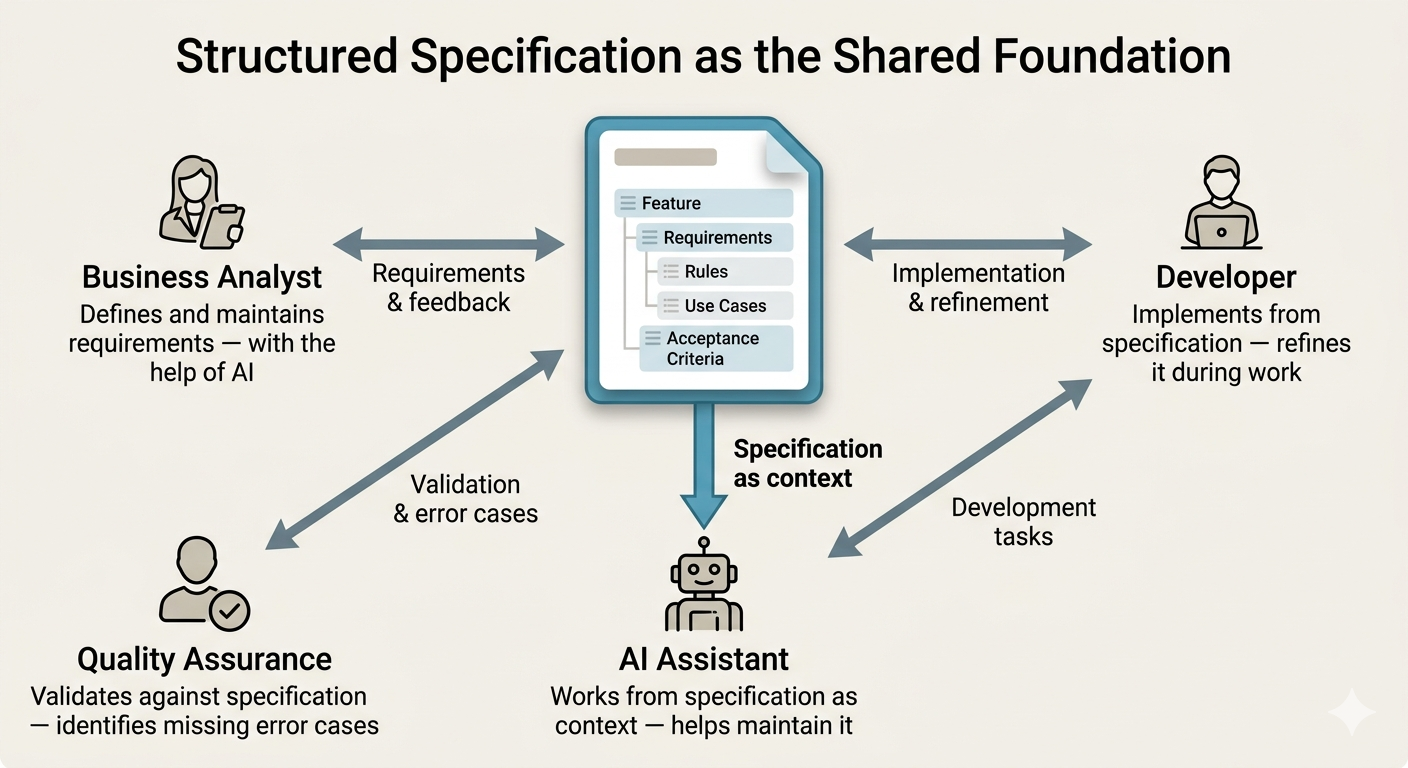
But in large projects, the real challenge is not whether AI can produce code. The real challenge is whether it has been given a clear enough description of what the software is supposed to do.
In a small project, one experienced developer can often keep much of the relevant understanding in their head. In a large initiative, that is no longer possible. The software is shaped not only by developers, but also by business stakeholders, product owners, domain experts, testers, architects, integration specialists, and sometimes regulatory requirements. Before a system can be built well, all of that input needs to be turned into something structured, consistent, and detailed enough to guide implementation.
If that information is not maintained properly, it becomes scattered across tickets, meetings, chat threads, wiki pages, and people’s memory. When that happens, both people and AI start working with partial understanding. The result may look correct on the surface and still be wrong.
Take a simple example. An AI tool is asked to implement an approval workflow. It creates the feature cleanly and efficiently, but nobody explicitly told it one important business rule: the same person must not approve their own purchase request. The mistake may well be caught before release, but by then time has already been spent building and reviewing the wrong behavior.
This is exactly why structured specifications matter.
Meliora Testlab is built around the idea that specification – requirements, rules, constraints, and acceptance criteria should not live as scattered notes. They should be maintained as a structured specification that supports the whole project. That same structure is also what makes the information usable for AI-assisted development.
In larger solutions, this cannot realistically mean one long flat document. A structured specification evolves during the project. Some parts may already be approved, some may be work in progress, and some may be assigned to specific people. That matters when many people are involved, because work becomes easier to coordinate and responsibility becomes visible. It is also much easier to find the right information when it is organized into a deliberate structure instead of being buried across unrelated materials.
The structure helps AI as well. When requirements are organized into meaningful sections and linked to related items, AI tools can use that structure to find the right parts and better understand what belongs together. This reduces the need to explain the same things again and again in prompts, and it improves the chances that the generated implementation actually matches the intended behavior.
For the buyer, this is not only about developer productivity. It is about whether AI-assisted development can be used in a controlled way in large projects. When shared understanding is anchored in a maintained specification, AI stops being just an individual helper and becomes something that can support the delivery model of the project as a whole. That means less unnecessary work, fewer misunderstandings, smoother onboarding, and a better path from business need to working software.
We at Meliora already use internal capabilities that bring specifications more directly into AI coding workflows, including environments such as Claude Code. These capabilities will be released more broadly in the future. The direction is clear: the organizations that benefit most from AI will not be the ones that simply adopt the newest model, but the ones that can give it reliable and well-structured guidance.
AI is changing software development right now. In large projects, the winners will not be the ones who only generate code faster. They will be the ones who can describe, organize, and maintain what needs to be built.
Contact us if you would like to see how this works in practice with Meliora.